

Dermatologic surgeons frequently encounter patients with synchronous, adjacent skin tumors, especially on the face. In such cases, when direct closure is not feasible, an optimal reconstructive strategy is to excise both lesions and reconstruct the defect using a single local flap.1 The “jigsaw puzzle” advancement flap is a versatile flap that was initially described by Goldberg in 2005 to repair surgical defects involving the lateral nasal ala.2
We report the case of an 87-year-old woman with a history of non-melanoma skin cancer who was referred to dermatology for surgical excision of three basal cell carcinomas: one on the forehead, one near the nasal alar crease, and another in the left infraorbital region (Fig. 1A). The defect from the forehead lesion was closed directly. For the remaining two lesions, a puzzle flap was designed, incorporating the infraorbital defect into the Burrow’s triangle at the superior pole of the flap (Fig. 1B).
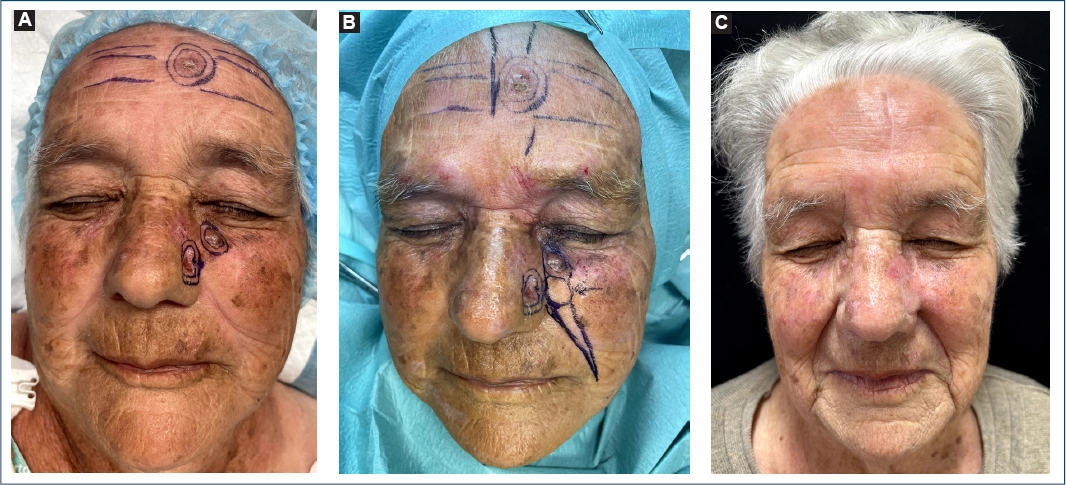
Figure 1.Figure 1. Clinical images. A: basal cell carcinomas located on the forehead, left alar crease, and infraorbital region. B: jigsaw puzzle advancement flap designed to incorporate both tumors. C: 9-month follow-up showing satisfactory cosmetic results.
No intraoperative or post-operative complications were observed. Histopathological examination confirmed complete excision of basal cell carcinomas (infiltrative and nodular subtypes). At the 9-month follow-up, a satisfactory cosmetic and functional outcome was documented (Fig. 1C).
In cases involving two adjacent facial tumors, planning excisions to allow reconstruction with a single flap may offer superior esthetic and surgical results. We hope that this case encourages consideration of the puzzle flap as a viable reconstructive option in similar scenarios.
Funding
None.
Conflicts of interest
None.
Ethical considerations
Protection of humans and animals. The authors declare that no experiments involving humans or animals were conducted for this research.
Confidentiality, informed consent, and ethical approval. The authors have followed their institution’s confidentiality protocols, obtained informed consent from patients, and received approval from the Ethics Committee. The SAGER guidelines were followed according to the nature of the study.
Declaration on the use of artificial intelligence. The authors declare that no generative artificial intelligence was used in the writing of this manuscript.
