

A 33-year-old woman presented with a 6-month history of a gradually increasing papule on her right breast. A 17 mm red-violet, asymptomatic, relatively indurated dome-shaped nodule was identified (Fig. 1A). Dermoscopic examination (Fig. 1B) revealed a central homogeneous bluish-gray area with a few short linear-irregular vessels, an erythematous area with shiny whitish structures and a pigmented pseudo-network. Ultrasound examination revealed a cystic hypoechoic mass. Excision of the lesion was proposed, and the patient was at her 36th week (+4 days) of pregnancy on the day of the procedure. Histologic examination revealed an apocrine hidrocystoma.
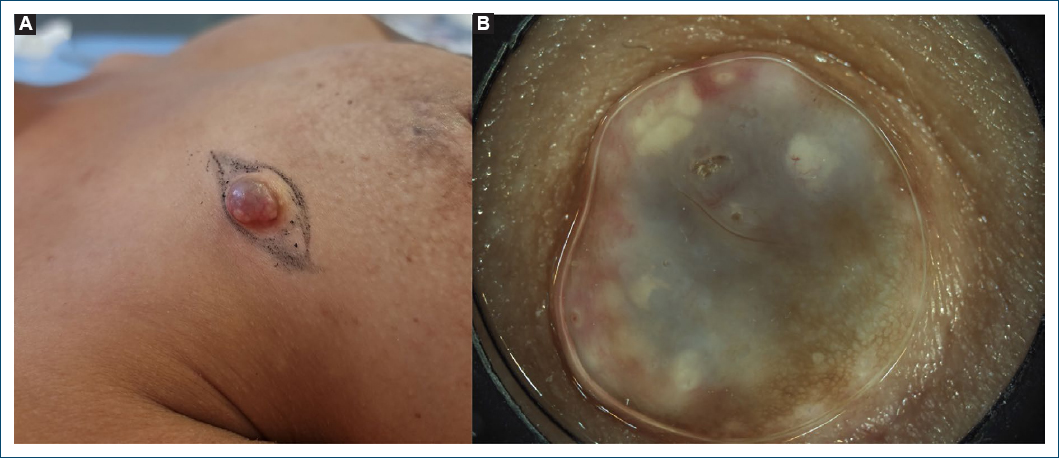
Figure 1. Clinical images. A: clinical picture of the dome-shaped nodule on the right breast; B: dermoscopy of the apocrine hidrocystoma in vivo before excision.
Apocrine hidrocystomas are benign tumors of the apocrine sweat glands most frequently found on the head and neck.1 Few have been reported in other areas.1–4 Most grow to sizes varying from 1 to 10 mm; there are only few reports of larger lesions.2 Our dermoscopic findings do not correspond to the most frequent patterns reported by Zaballos et al.1 gray and pink homogenous areas and linear-irregular vessels were only found in 4.8% and 9.1% of reported cases; moreover, pigmented pseudo-networks have not been described.1 In the differential diagnosis, atypical dermatofibroma, pigmented basal cell carcinoma, amelanotic melanoma or other adnexal tumors should be considered, particularly when atypical dermoscopic findings are present.3 We hypothesize that a pigmented pseudo-network may have been caused by irritation derived from a chronic inflammatory process. The atypical findings of our hidrocystoma enhance the need for physicians to be aware of uncommon locations and dermoscopic findings of these lesions.
Funding
None.
Conflicts of interest
None.
Ethical considerations
Protection of human subjects and animals. The authors declare that no experiments on humans or animals were performed for this research.
Confidentiality, informed consent, and ethical approval. The authors have followed their institution’s confidentiality protocols, obtained informed consent from all patients, and secured approval from the Ethics Committee. SAGER guidelines have been followed as applicable to the nature of the study.
Declaration on the use of artificial intelligence. The authors declare that no generative artificial intelligence was used in the writing or creation of the content of this manuscript.
