Introduction
Adverse drug reactions affecting the skin are common and present with a diverse pattern of expressions. Cutaneous hypersensitivity reactions range in severity, from mild reactions to severe cutaneous adverse reactions (SCARs).1 To be included in SCAR, the following criteria are to be fulfilled: (1) severe (associated to a significant morbidity and mortality and usually leading to hospitalization); (2) non-predictable (idiosyncratic, and probably of immunological mechanism); and (3) most often induced by drugs.1 DRESS is a distinct SCAR characterized by potentially life-threatening hypersensitivity reaction with extensive rash, fever, and internal organ involvement, including liver and kidney, occurring most commonly 2-6 weeks after initiation of a medication.2 Here, we describe a case of DRESS syndrome caused by vancomycin.
Case report
A 62-year-old female was admitted to a tertiary care hospital presenting with high-grade fever, a progressively worsening maculopapular rash, peripheral eosinophilia, and evidence of hepatic and renal dysfunction. On examination, the patient was alert and fully oriented. A diffuse blanching erythema with desquamation was noted over the face, back, and extremities (Figs. 1–3), while the oral mucosa remained unaffected. No lymphadenopathy was detected. The patient’s medical history revealed prior hospitalization for burn management, during which she was treated with vancomycin (2 g/day) for a MRSA infection. She denied any concurrent medications or known drug allergies. Approximately 3 weeks after initiating vancomycin therapy, she developed the aforementioned symptoms.
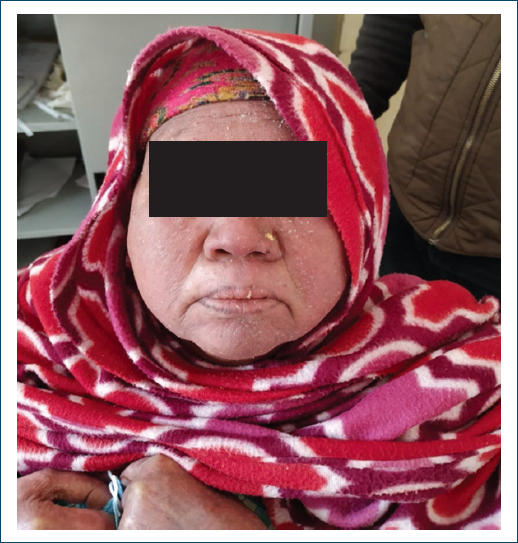
Figure 1. Drug reaction with eosinophilia and systemic symptoms syndrome with marked facial exfoliative dermatitis and swelling.
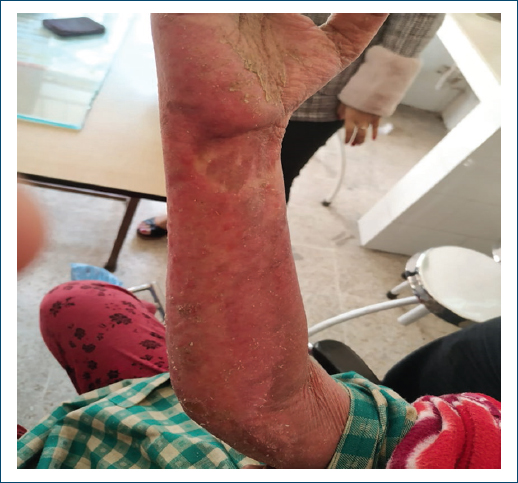
Figure 2. Generalized exfoliative dermatitis in the context of drug reaction with eosinophilia and systemic symptoms, with a detail on the forearms.
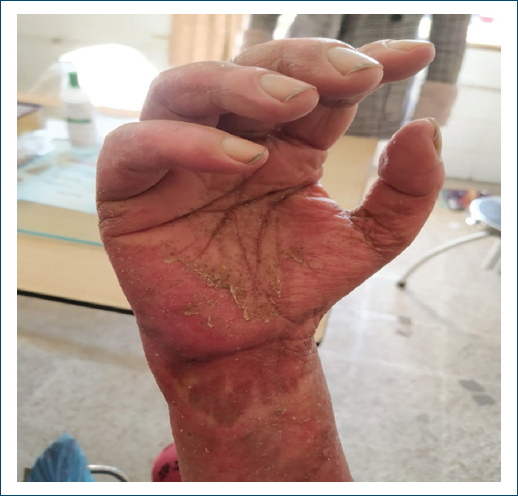
Figure 3. Details of the hand involvement in the case of generalized exfoliative dermatitis in the context of drug reaction with eosinophilia and systemic symptoms from vancomycin.
Laboratory investigations conducted both before and following the onset of symptoms (Table 1) demonstrated hematological abnormalities, impaired liver function, and declining renal parameters. Serological tests for hepatitis A, B, C, and E viruses, as well as human immunodeficiency virus (HIV)-1 and HIV-2, were all negative. A diagnosis of drug reaction with eosinophilia and systemic symptoms (DRESS) was established based on hematological findings, hepatic and renal involvement, and exclusion of other etiologies.
Table 1. Laboratory parameters before and after the onset of vancomycin
| Investigations | Before starting of vancomycin | At 3 weeks of vancomycin | After stopping vancomycin and 7 days of methylprednisolone |
|---|---|---|---|
| Hemoglobin (g %) | 9.6 | 9.5 | 9.5 |
| Total leucocyte count (n/mm3) | 7800 | 14,000 | 10,000 |
| Polymorphs (%) | 55 | 53 | 53 |
| Eosinophils (%) | 1 | 26 | 14 |
| Absolute eosinophils count (/mm3) | 200 | 3800 | 1900 |
| Atypical lymphocytes | Absent | Present | Present |
| Platelets (/mm3) | 2.3 × 10⁵ | 2.3 × 10⁵ | 2.23 × 10⁵ |
| Urea (mg/dL) | 18 | 20 | 20 |
| Creatinine (mg/dL) | 1 | 3 | 2 |
| Serum bilirubin (mg/dL) | 0.8 | 3 | 1.3 |
| Alanine aminotransferase (U/L) | 26 | 152 | 91 |
| Aspartate aminotransferase (U/L) | 28 | 378 | 218 |
| Alkaline phosphatase (U/L) | 58 | 188 | 86 |
| Antinuclear antibody | Negative | Negative | Negative |
| Urine protein | Nil | Traces | Traces |
According to the RegiSCAR diagnostic criteria, the case was classified as “definite DRESS” with a score of 6, considering the presence of fever, eosinophilia (> 1500/μL), atypical lymphocytes, rash involving over 50% of the body surface with purpuric features and infiltration, and multi-organ involvement. The Naranjo adverse drug reaction probability scale yielded a score of 8, indicating a “probable” association with vancomycin. The patient was managed promptly with systemic corticosteroids methylprednisolone 125 mg (approximately 1.25 mg/kg daily, body weight 98.3 kg) for 3 days. She was treated with tapering oral prednisolone for an additional 2 weeks and antihistamines, resulting in significant clinical improvement and normalization of hematological, hepatic, and renal parameters (Table 1).
Discussion
The term DRESS was first proposed by Bocquet et al. in 1996.2 DRESS is a dermatological emergency with a reported mortality rate of approximately 10%.3 Its incidence is estimated at 1 in 1,000 to 1 in 10,000 drug exposures.4 The underlying pathophysiology remains incompletely defined but is thought to involve an immune-mediated mechanism, potentially influenced by viral reactivation.5 Early in the disease course, reductions in circulating B lymphocytes and serum immunoglobulin levels have been observed.5 Elevated inflammatory cytokines are commonly present, with interleukin-5 often peaking several days before the onset of eosinophilia.6
Diagnosis relies on both clinical features and laboratory data. Typical lab findings include eosinophilia or atypical lymphocytosis, elevated transaminases, increased creatinine, and pyuria, indicating possible hepatic and renal involvement.7 Our patient presented with fever, rash, eosinophilia, and transaminitis. Cutaneous symptoms generally appear 2-8 weeks after initiating the causative drug and may continue after its withdrawal.7 In this case, the rash developed 3 weeks after starting antibiotic therapy.
In the European registry of SCARs to drugs and collection of biological samples (RegiSCAR) study, a definitive drug-related cause was identified in 88% of DRESS cases, whereas the cause remained uncertain in only 2%.8 In our patient’s case, DRESS syndrome likely developed as a result of vancomycin exposure. Vancomycin is responsible for approximately two-thirds of antibiotic-related DRESS cases.9 According to a study using electronic health records, 74% of DRESS incidents were linked to antibiotics, with the majority caused by vancomycin, followed by beta-lactams.10
Because the clinical symptoms of DRESS can vary widely, a scoring system called the RegiSCAR Criteria was developed to assist with diagnosis.11 According to this system, the patient received a total of seven points: one point for fever, two points for eosinophilia over 1500/uL, two points for skin involvement and biopsy indicating a drug reaction, two points for kidney and lung involvement, and negative results for antinuclear antibody, blood cultures, and hepatitis tests. The criteria are scored from 4 to 9, with scores of < 2 excluding the diagnosis of DRESS, 2-3 being possible, 4-5 probable, and score > 5 being definite. In our case, the patient’s RegiSCAR score was 6.
The cornerstone of management for DRESS syndrome involves discontinuation of the offending agent alongside corticosteroid therapy. Given vancomycin’s extended half-life, hemodialysis may be considered in severe, refractory cases, with a single session capable of removing up to 50% of plasma vancomycin concentrations.12 Our patient exhibited marked clinical and biochemical improvement following corticosteroid administration. Consequently, the patient was discharged with outpatient follow-up arranged to monitor resolution and facilitate corticosteroid tapering.
Conclusion
Diagnosing DRESS is difficult due to its variable symptoms, which can resemble many other conditions. This challenge is heightened because DRESS typically appears later than other drug reactions, usually 2-6 weeks after starting a medication, rather than 1-3 weeks. However, quickly identifying the syndrome and stopping the offending drug is crucial, as DRESS can be life-threatening but is often reversible. More research is needed to improve early diagnosis and develop better treatment guidelines to reduce the illness and death associated with this condition.
Funding
None.
Conflicts of interest
None.
Ethical considerations
Protection of humans and animals. The authors declare that no experiments involving humans or animals were conducted for this research.
Confidentiality, informed consent, and ethical approval. The authors have followed their institution’s confidentiality protocols, obtained informed consent from patients, and received approval from the Ethics Committee. The SAGER guidelines were followed according to the nature of the study.
Declaration on the use of artificial intelligence. The authors declare that no generative artificial intelligence was used in the writing of this manuscript.
