

Introduction
Achenbach syndrome, first described in 1958 by Walter Achenbach, is a benign and self-limited vascular condition characterized by sudden-onset subcutaneous bleeding of the fingers, most frequently affecting middle-aged women.1 Although its exact pathophysiology remains unclear, proposed mechanisms include capillary fragility, microhemorrhages, vasomotor instability, and a possible genetic predisposition.2,3 Despite its harmless course, its abrupt and dramatic clinical presentation often raises concern for more serious vascular disorders such as acute digital ischemia, vasculitis, or thromboembolic events, frequently prompting extensive investigations.3,4 Improving clinical awareness allows clinicians to recognize this entity promptly, avoid unnecessary diagnostic workup, and reduce patient anxiety.
Case report
A 48-year-old woman presented with a sudden-onset violaceous discoloration of the third finger of her left hand. Symptoms developed over several hours without preceding trauma, cold exposure, medication changes, or systemic complaints. Clinical examination revealed violaceous discoloration and mild oedema localized to the palmar aspect of the middle phalanx, with sparing of the fingertip and nail bed (Fig. 1). Radial and ulnar pulses were intact, and Allen’s test was normal. Sensory and motor examination was unremarkable.
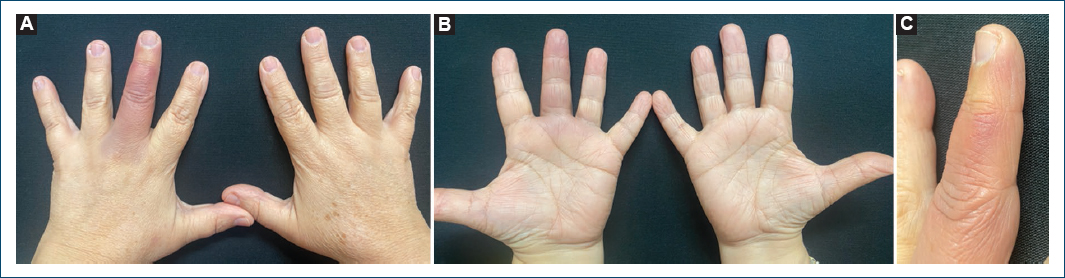
Figure 1. A and B: violaceous discoloration and mild swelling of the third left finger. C: nail bed and fingertip are spared.
Laboratory investigations, including complete blood count, coagulation profile, and inflammatory markers, were unremarkable. Given the characteristic presentation and absence of red flags, no imaging was performed. The patient was reassured, and symptoms resolved spontaneously within 7 days without intervention.
Discussion
Achenbach syndrome is a benign vascular phenomenon characterized by acute-onset pain, swelling, and bluish discoloration of one or more fingers.1,3,5,6 It most frequently involves the index, middle, or ring fingers, particularly the proximal and middle phalanges, classically sparing the fingertip.5–7 Associated symptoms may include paresthesia, pruritus, or transient stiffness, but systemic signs are absent.
Although its etiology remains incompletely understood, the most accepted hypotheses involve increased vascular fragility and microhemorrhages within the dermis.2,5,7,8 Some authors suggest a potential role for vasospasm, hematoma-induced compression, or subtle arterial functional changes.5–7 Histopathological findings in selected cases demonstrate erythrocyte extravasation and capillary ectasia, supporting these mechanisms.5,6
Diagnosis is clinical, and routine laboratory and imaging investigations are usually normal.2–4 The dramatic presentation often leads to suspicion of acute ischemia, vasculitis, Raynaud’s phenomenon, digital venous thrombosis, or Gardner-Diamond syndrome, but these conditions differ in clinical evolution, systemic involvement, or laboratory abnormalities.2 Recognition of the typical presentation can prevent unnecessary use of Doppler ultrasound, Computed Tomography angiography, echocardiography, or autoimmune testing.4 No treatment is advised. Increased clinical recognition can reduce patient anxiety, limit unnecessary investigations, and prevent inappropriate referrals to specialties such as rheumatology, hematology, or vascular surgery.5–7
Conclusion
Achenbach syndrome is a benign, self-limited vascular condition that should be diagnosed clinically. Awareness of its characteristic presentation allows clinicians to avoid unnecessary investigations and provides reassurance to patients experiencing this alarming but harmless condition.
Funding
None.
Conflicts of interest
None.
Ethical considerations
Protection of humans and animals. The authors declare that no experiments involving humans or animals were conducted for this research.
Confidentiality, informed consent, and ethical approval. The authors have followed their institution’s confidentiality protocols, obtained informed consent from patients, and received approval from the Ethics Committee. The SAGER guidelines were followed according to the nature of the study.
Declaration on the use of artificial intelligence. The authors declare that no generative artificial intelligence was used in the writing of this manuscript.
