

Introduction
MMP®, an acronym for microinfusion of drugs into the skin, is an innovative technique developed in Brazil that consists of microneedling performed with professional tattoo devices for the transdermal delivery of pharmacological agents.1 It has been applied as an adjuvant treatment for androgenetic alopecia, particularly in cases of female pattern hair loss.2,3 The method enables uniform infusion of substances into the dermis at an average depth of 1.0 to 1.5 mm, adjusted according to the clinical condition1. The procedure is generally well tolerated, with no reports of severe adverse events.3
This article describes the case of a patient who developed an unexpected complication following MMP® on the scalp, addressing its clinical, trichoscopic, and therapeutic aspects.
Case report
A 44-year-old female patient underwent a session of MMP® on her scalp, utilizing minoxidil and dutasteride to treat FPHL (Fig. 1). Two days post-procedure, she dyed her hair and unexpectedly observed several linear scalp pigmentations, which caused her significant distress. In the following days, trichoscopic examination revealed pigmentation at the entry points of the microneedles from the MMP® procedure, resembling a tattoo, likely due to hair dye impregnation (Fig. 2). To address this issue, a daily regimen of exfoliating shampoo and a topical solution containing corticosteroids and salicylic acid was recommended. Fortunately, after 7 days, the patient achieved complete resolution of the scalp pigmentation.
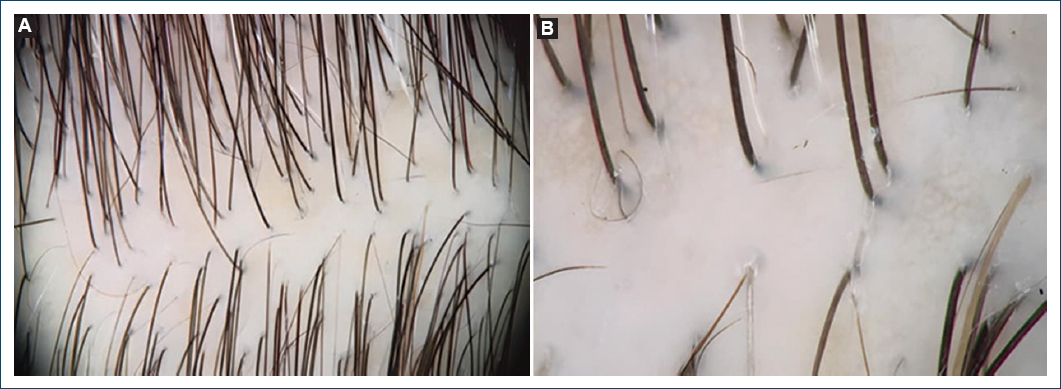
Figure 1. Trichoscopy before the MMP® procedure. Magnification: A: ×20 and B: ×70.
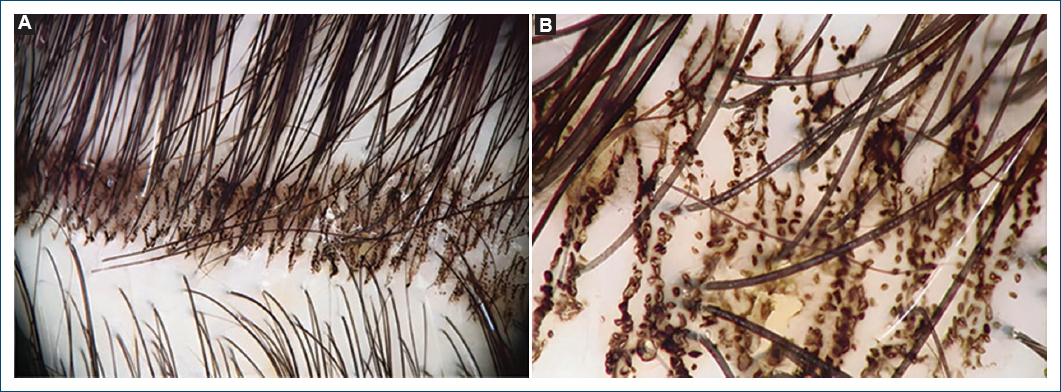
Figure 2. Trichoscopy after MMP® procedure. Images reveal the pigmentation at the entry points of the micro-needles. Magnification: A: ×20 and B: ×70.
Discussion
The MMP® procedure is performed using the Cheyenne tattoo machine along with sterile 27-Magnum needle cartridges to infuse medication into the skin.2 The entry holes created by the 27-needle cartridge range from 6 to 10 microns in diameter, significantly smaller than the 0.3 mm diameter of a traditional needle shaft.1,2
While previous reports have suggested that MMP® openings close within approximately 4 h, thereby limiting further drug permeation, our case challenges this notion.4 The patient experienced temporary tattoo-like linear pigmentations resulting from topical particles applied 2 days after the MMP® procedure.
Overall, MMP® is associated with mild side effects, such as temporary pain and erythema at the application site, with no serious adverse events reported3. In this article, we present an additional side effect of MMP® that has not been previously described; nevertheless, it remains a safe treatment option.
This report underscores a potential post-procedure complication that can lead to both psychological and cosmetic concerns. It raises important questions regarding the optimal timing for recommending the use of hair dye, makeup, and hair fibers after MMP®, emphasizing the need to advise patients to observe a longer waiting period than previously believed before applying hair dye. Dermatologists must remain vigilant about this complication, particularly as MMP® gains popularity in treating common conditions like FPHL.
MMP® remains a safe option for the adjuvant treatment of Androgenetic Alopecia. Despite the report of another unexpected adverse event, its side effects are few, temporary, and not severe.
This article emphasizes the need for dermatologists to advise patients on delaying the use of hair dye and similar products after MMP® treatment to prevent cosmetic concerns. This report calls for increased awareness of potential complications as MMP® becomes more widely adopted for treating FPHL.
Funding
None.
Conflicts of interest
None.
Ethical considerations
Protection of human subjects and animals. The authors declare that no experiments on humans or animals were performed for this research.
Confidentiality, informed consent, and ethical approval. The authors have followed their institution’s confidentiality protocols, obtained informed consent from all patients, and secured approval from the Ethics Committee. SAGER guidelines have been followed as applicable to the nature of the study.
Declaration on the use of artificial intelligence. The authors declare that no generative artificial intelligence was used in the writing or creation of the content of this manuscript.
